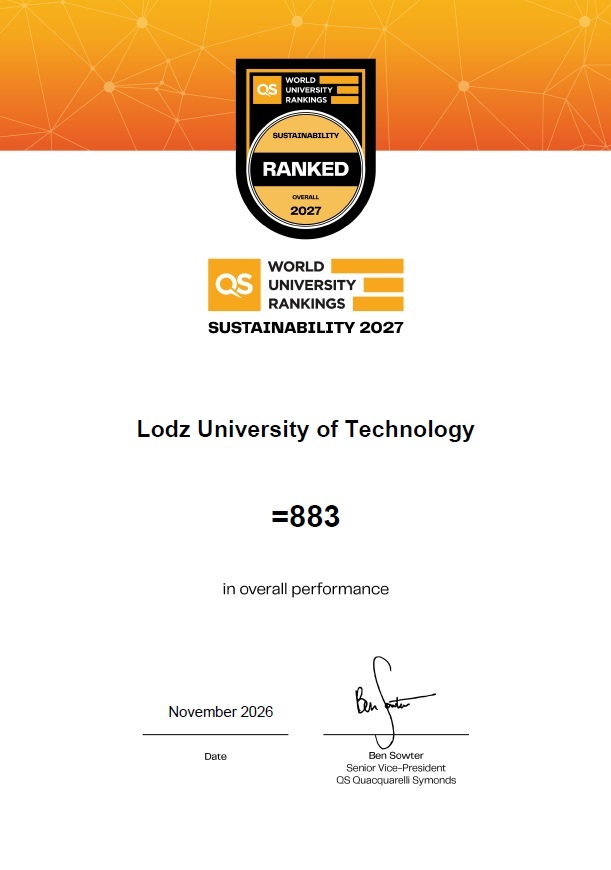
In this year's ranking, Lodz University of Technology was placed 833rd worldwide, improving its position by more than 200 places compared to the previous edition, in which it was ranked in the 1051-1060 band. The university also moved up in the European ranking, reaching 339th place, and ranked 14th among the 26 Polish institutions included in the ranking.
Some of the university's most notable improvements were recorded in areas related to environmental sustainability. In the Environmental Impact category, TUL ranked 871st worldwide, advancing by more than 200 places. Significant progress was also achieved in Environmental Sustainability, where the university moved up by more than 300 places to 800th position, and in Environmental Research, where it ranked 829th, improving by more than 250 places.
In the Social Impact category, TUL ranked 1050th globally, climbing nearly 200 places. At the same time, one of the university's strongest domain remains Health & Wellbeing, which evaluates universities' contributions to improving health and well-being through research and initiatives supporting students and staff. In this category, TUL was ranked 401st in the world.
The 2027 edition of the ranking included 2,003 institutions from 107 locations worldwide, reflecting the growing importance of sustainability-related activities in higher education. The top positions in the ranking were occupied by: Lund University (Sweden), ETH Zurich (Switzerland) and University of Toronto (Canada). Among Polish universities, the highest places were secured by: the University of Warsaw (326th), the University of Gdańsk (359th) and Jagiellonian University (365th).
The QS Sustainability Rankings evaluate universities’ contributions to building a more sustainable future. The assessment is based on 53 indicators grouped into three areas: Environmental Impact, Social Impact, and Governance. The methodology takes into account, among other factors, research performance, contributions to the United Nations Sustainable Development Goals (SDGs), graduates’ impact on science and technology, and practices related to social responsibility and institutional governance.