
For me, Erasmus was an amazing adventure!
I had the opportunity to take part in two semester-long mobilities – in Aveiro, Portugal, and Tampere, Finland – as well as seven short-term mobilities. I visited the following countries: Portugal, the Netherlands, Lithuania, Sweden, Italy, Norway, Finland, and Croatia.
Thanks to the opportunities offered by Erasmus, I met many wonderful people and developed my language skills. In my opinion, short-term Erasmus mobilities are perfect for people who want to learn something new during a one-week course while also meeting a group of new friends. A long-term mobility, on the other hand, is more suitable for those who want to immerse themselves more deeply in another country’s culture, learn the basics of the local language, and experience everyday life in a different place.
Moreover, experiencing another culture had a positive impact on how much I appreciate the country where I grew up – Poland – and the things that I used to take for granted in my everyday life.
Scholarship
During both of my long-term exchanges, I felt that the scholarship was able to cover the additional costs. However, the university and the EU seem to assume that you are already able to support yourself in Poland, so by “additional costs” I mean mainly the cost of travelling to the destination country and renting accommodation. I think that, in order to support yourself comfortably while also being able to enjoy the exchange, it is worth having some savings. This gives you the opportunity to explore the country, eat out, and cover other expenses without constantly worrying about your budget. As for the scholarship for short-term mobilities, it comfortably covers all the costs.
It is also worth mentioning that Ryanair offers an ESN discount: 10% off flights and the possibility of bringing a free 20 kg checked bag on four flights. You can join ESN automatically as a mobility student.
Tampere University (August – December 2025)
I went to Tampere University as a third-semester student in the Smart Manufacturing programme (IFE/Faculty of Mechanical Engineering).
Accommodation – I lived in a two-person apartment. It was somewhat like a student dormitory, but with a very high standard, and it was approximately 53 m². I had my own room, while I shared the common areas – the kitchen and living room, as well as the bathroom – with one other girl.
University – Everyone speaks English, and the university community is very welcoming and well adapted to international students. I did not have any problems with my courses. The university cafeteria offers delicious, nutritious, and affordable food, which was a huge advantage during my stay.
Public transport – It is excellent. It is worth booking trains in advance, as tickets are then cheaper. The student discount applies to people who have a Finnish student card (ISIC is not accepted). Trains, buses, trams, and the metro (in Helsinki) – everything works really well.
Travelling and sightseeing – Finland is definitely a much larger country than Portugal, so the distances are greater and travelling takes considerably more time. It is worth keeping this in mind when planning trips.
The cities I managed to visit were: Tampere, Turku, Helsinki, Riga (Latvia), Tallinn (Estonia), Oulu, Vaasa, Rovaniemi, and Kemi.
And, of course, there were experiences that I will remember forever: I fed reindeer in Lapland, visited Santa Claus in Rovaniemi, picked cranberries in Finnish forests, watched several ice hockey games live, and ate lots of delicious food (!).
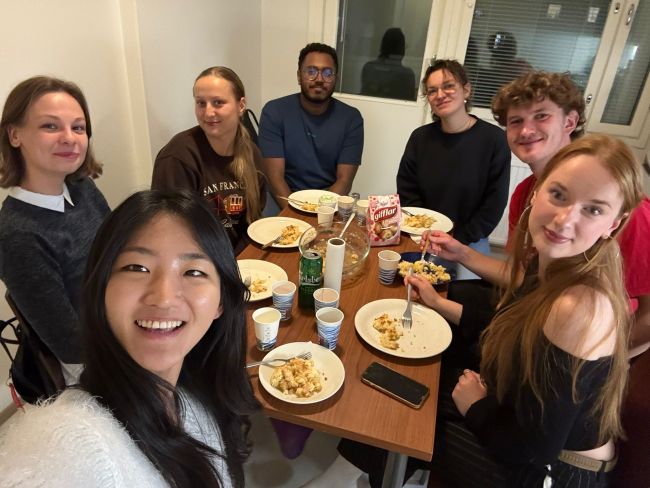
University of Aveiro (September 2023 – February 2024)
I went to the University of Aveiro as a seventh-semester student in Management Engineering (OIZ).
Accommodation – I lived in a rented room in a five-person apartment. Before going abroad, it is worth making sure that the apartment actually exists, as there are many people who try to take advantage of Erasmus students and scam them.
University – The university offers courses in English, but the selection is limited. It was necessary to contact the lecturer in advance to ask whether they could teach the course in English or arrange for Erasmus students to complete the course requirements in English (there usually wasn’t a problem with this). In the end, I took three courses that were officially taught in Portuguese (I did not have to attend the classes, and I was able to complete the exams/assessments in English) and two courses that were taught entirely in English.
The campus is very much what you would expect from a university in southern Europe. Every faculty building has a small café where you can get a coffee for €1 and something sweet to eat. There are also canteens and a restaurant on campus where you can buy a meal every day for just a few euros. Personally, I preferred eating at the restaurant or preparing my own meals at home.
Public transport – Trains and FlixBus are fine. The metro in Porto and Lisbon works great, but I never actually used the city buses in Aveiro, for example.
Travelling and sightseeing – The cities and places I managed to visit included: Aveiro, Porto, Lisbon, Bragança, Barcelos, Vigo (Spain), the Azores, Madeira, Viana do Castelo, Faro, Nazaré… and that’s not even everything!
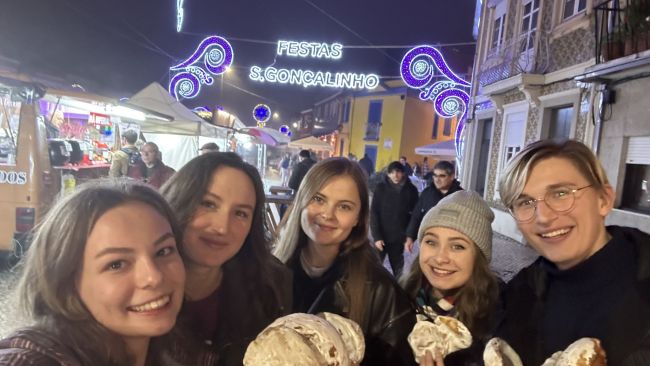
Finland vs. Portugal
Everyone asks me to compare Finland and Portugal, but in my opinion, it is impossible to say which one is better. They are simply very different experiences.
In Portugal, summer temperatures lasted until the end of October, so I spent a lot of time outdoors. Almost all social activities took place outside, and there was also the beach, which made it very easy to enjoy the weather and spend time outdoors.
Finland, on the other hand, was much easier to manage from an organisational point of view. I remember that after my first Erasmus, I told myself that I definitely wanted to go abroad again, but this time to a place where I wouldn’t have to stress about my courses – whether lecturers would agree to teach me in English, whether I would be able to complete the requirements, etc. During my first exchange, I ended up adding many courses only after arriving and making changes to my Learning Agreement. I also didn’t want to have to worry about finding accommodation on my own.
Finland gave me exactly that. The whole process was much easier and more organised, which allowed me to focus more on enjoying the exchange itself. Additionally, I got to explore a country that is not usually the first place people think of when planning a holiday.
It is also worth mentioning that the semester in Finland was shorter. I had already returned home for Christmas after passing my exams, whereas in Portugal, I had to go back to the university after the Christmas break to take my exams.
Sonia, Smart Manufacturing student
Swój staż w Tajwanie oceniam bardzo pozytywnie i z pewnością poleciłabym go innym studentom. Dla mnie była to świetna okazja do poznania nowego podejścia do analizy dużych zbiorów danych. Podczas cotygodniowych spotkań mój profesor wspierał mnie merytorycznie, omawiając postępy i sugerując dalsze kierunki pracy. Zyskałam cenne doświadczenie i nauczyłam się myśleć jak badacz zajmujący się danymi biomedycznymi.
Poza pracą naukową, miałyśmy wraz z koleżanką okazję poznać kulturę Tajwanu. W samym Tainanie można skorzystać z wielu nietypowych atrakcji, takich jak kawiarnie z kapibarami, kotami czy surykatkami. Warto wiedzieć, że Tainan jest byłą stolicą Tajwanu, stąd zachowało się tam najwięcej świątyń oraz tradycyjnych, chińskich zabudowań. Zwiedziłyśmy także wiele muzeów, gdzie wstęp jest zaskakująco tani (zwykle 4–6 zł), odwiedziłyśmy plażę, a dzięki szybkim pociągom HSR zobaczyłyśmy Tajpej oraz górskie miasteczko Jiufen. Będąc na Tajwanie koniecznie trzeba przejść się na nocny market i spróbować tam lokalnego jedzenia – w Tainanie szczególnie polecam Dadong Night Market, otwarty w niedziele i poniedziałki.
Stypendium otrzymałyśmy pod koniec listopada, a mimo aktywnego zwiedzania i braku oszczędzania nie byłam znacząco “na minusie”. W Tainanie 50 000 NTD na dwa miesiące (plus do 30 000 NTD na bilety lotnicze) wystarcza na pokrycie większości kosztów, nawet jeśli mieszka się w droższym akademiku - my wybrałyśmy ten świeżo po remoncie, o wysokim standardzie i z dużą kuchnią. Dla przyszłych uczestników poleciłabym dodatkowe 2–3 tysiące złotych, aby móc swobodnie korzystać z atrakcji i komfortowo podróżować. Warto też zarezerwować bilety na HSR z co najmniej tygodniowym wyprzedzeniem, ponieważ bez rezerwacji przejazd z Tainan do Tajpej kosztuje ok. 1150 NTD w jedną stronę.
To doświadczenie połączyło rozwój naukowy z fascynującą przygodą i serdecznie polecam je wszystkim zainteresowanym!
Kornelia, studentka na kierunku Mathematical Methods in Data Analysis